
a strategy for a
regenerative business model
integrating sustainable farming ecosystems
in the workplace, within the urban environment
Urban Farming by Design (UFbD)
encompasses principles of
sustainability, community, innovation, and environmental stewardship
Sustainability
UFbD is committed to promoting environmental sustainability by integrating organic farming practices, reducing waste and pollution, conserving energy and water, and fostering a purpose-driven circular economy model that maximizes local resources.
Community
UFbD values the power of community and seeks to create spaces where people can come together to learn, connect, and engage with nature. We prioritize building solid relationships with businesses, institutions, and organizations to foster a sense of belonging in the workplace and a shared responsibility for the environment.
Innovation
UFbD embraces innovation as a driving force for positive change. We continually seek out new techniques and approaches to urban farming and sustainable living, pushing the boundaries of what is possible to create regenerative solutions to complex environmental challenges
Environmental Stewardship
UFbD recognizes the importance of responsible stewardship of the natural world. We strive to minimize our ecological footprint by prioritizing regenerative permaculture design ethics and principles, protecting biodiversity, and conserving natural resources for future generations.
Are You Ready to Rethink What an Institution Can Become?
Urban Farming by Design is a methodology that integrates regenerative farming into institutional landscapes, transforming underused spaces into thriving ecosystems for users, nature, and community
Can leadership provide a framework for a productive ecosystem that elevates the worksite and workforce, strengthens ESG performance, and builds climate resilience?

This is an invitation to transform a mere workspace into a vibrant ecosystem that fosters a true culture of resilience and shapes the institution's future.
Waste from the farm and bistro´s kitchen becomes compost.
Roof solar collectors provide energy for the whole site.
The urban farm is close to workplaces such as businesses, industrial and college campuses, or housing developments to allow easy walk and bike access.
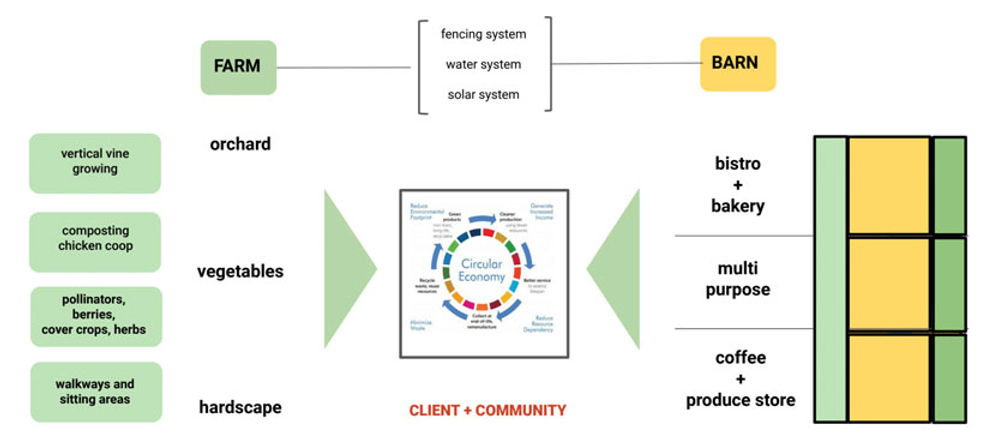
Each UFbD prototype has two main components:
the Farm and the Barn, both interconnected by circular economy practice.
UFbD envisions a space where the farm and city converge to promote reconnection with nature, offering opportunities for learning and community experiences such as workshops, events, celebrations, and seasonal fruit harvesting.
The project embraces regenerative permaculture design ethics and principles, drawing inspiration from nature to develop eco-farming systems centered on plant biodiversity, guilds, soil fertility, and resource conservation.

© Meghiddo Architects 2023 - All Rights Reserved
Regeneration begins when circularity becomes the new normal, as circularity is no longer a concept but the new foundation.
It provides the foundation for engaging with resilience within the regenerative campus strategy.

there is much talking lately about reforestation of the cities in order to,
cool, clean, and improve the air quality in the city:
_edited.jpg)
CITY and FARM
CITY + FARM
CITY + FARM + FOREST
From City and Farm, to Urban Farming, to Urban Reforestation.
Tell me how can we make this path undeniable?
Urban Farming by Design is a Strategic Circularity Brand
for the Regenerative Urban Farming Business Model
Here is how institutions become regenerative

© Meghiddo Architects 2023 - All Rights Reserved
The Barn is a regenerative
architectural element.
It is a wood, steel, and glass frame warehouse containing the coffee shop, a multi-purpose area, and the bakery-bistro.
All the spaces are open towards the farm. Seating areas maximize indoor-outdoor possibilities.
The multi-purpose hall can provide community activities such as workshops, social events, celebrations, and participation in seasonal harvesting.
We envision the farm as a natural extension of the workplace where you find a moment of relaxation, grab a coffee, have a flavorful lunch and enjoy conversations with colleagues.
Can regenerative thinking become the new language of leadership? What if every decision created more value than it consumed?

Urban Farming by Design
business design model
serves as a
for-profit venture or a
non-profit initiative

© Meghiddo Architects 2023 - All Rights Reserved
the benefit of bringing Nature closer to the built environment is crucial for promoting a culture that contributes to a
healthier, happier, and sustainable world
Bucky Fuller said, “Think Globally, Act Locally.”
We like to paraphrase it and say:
Grow Locally, Think Globally

© Meghiddo Architects 2023 - All Rights Reserved
A Regenerative Vision May Transform Underused Institutional Land into Living Ecosystem


Founder, Ruth Meghiddo, AIA
Certified Permaculture Consultant
Meghiddo Architects, AIA
Architecture and Urban Design
collaborators
Rick Meghiddo, AIA
Architect, Documentary filmmaker
German Biglia
Architect, 3D designer, and site design
Bruce Melchor
site design


